Despite being a phrase that sounds like a copy-paste from a science fiction novel, the idea of a "Digital Dark Age" is very much real – and the consequences of one happening could be huge…
Share
SHARE
Since the dawn of cloud computing and the technological revolution of the 21st Century, the majority of the world’s data and information has been created and stored electronically…
And while many companies and institutions go to great lengths to protect data on remote servers and cloud services all over the globe, there are several scenarios that could happen in which vast amounts of this data could be lost – Also known as a ‘Digital Dark Age’.
What is a 'Digital Dark Age'?
In short, the phrase ‘Digital Dark Age’ describes a hypothetical scenario where vast amounts of digital information become damaged or inaccessible. As a result, this could create a significant void in our collective knowledge and understanding of the world.
Not only is this a concern in regards to preserving current historical data, but a lack of good practices in the present could also mean that the data we are creating and sharing today could, in the future, be lost forever.
Unlike physical information, such as books and artefacts that can survive for hundreds of years, digital information is at a higher risk of being lost forever. Whether it’s through decay, misplacement, accidental deletion or outdated file formats, it’s hard to estimate just how much data is already at risk of being lost forever and how many artefacts have already disappeared.
An advertisement for a 10 megabyte hard disk from Morrow Designs (1981) - Credit: VC&G (Vintage Computing & Gaming)
How a Digital Dark Age can Happen
A Digital Dark Age can occur due to several reasons, many of which can be linked back to the fact that digital information is fragile, regardless of various technological safeguards such as file encryption and making backups.
For example, physical media such as re-writable CDs, USB flash drives and internal/external hard drives are all at risk of deteriorating naturally over time, meaning that the data stored using these mediums can be at risk of permanent loss if it isn’t backed up elsewhere.
And not only are physical storage mediums susceptible to natural decay, but they can also be damaged due to several reasons, one of which is from natural disasters. As well as being a present and future risk, natural disasters have already caused widespread data loss and disruption for millions of people in the past decade alone.
Examples of Significant Data Loss
For a variety of reasons, there have been several famous cases where a significant amount of data or a specific artefact has been lost. Here are just a few examples that have occurred in recent times.
2005 – Hurricane Katrina
Known for being one of the most devastating hurricanes to ever hit the United States, Hurricane Katrina made landfall along Louisiana’s Gulf Coast in August 2005, causing unprecedented damage to the state and its capital, New Orleans, in particular.
Hurricane Katrina making landfall around New Orleans - NOAA (Public Domain)
According to an article published by NetworkWorld in 2006, BellSouth (a subsidiary of telecommunications giant AT&T) had invested around $1 billion in rebuilding the city’s damaged communication lines, including up to 100,000 fibre optic cables (source).
2010/11 – Queensland Floods
Over the 2010-2011 Christmas period, the northeastern Australian state of Queensland experienced one of the worst floods since 1974. Triggered by Tropical Cyclone Tasha, the worst of the flooding affected both coastal and inland towns and cities.
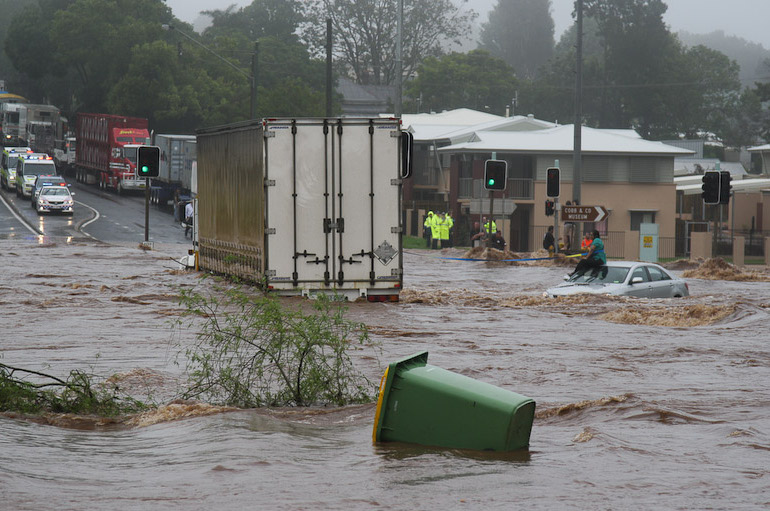
A woman waits on the roof of her car to be rescued - January 10 2011 (CC BY 2.0)
Brisbane, the sprawling state capital that sits on the Pacific Coast, was heavily affected by the disaster. However, data centres were described as having a ‘narrow escape’ when it came to telecommunications damage.
Despite the close shave, mobile phone operator Optus reported that their 2G and 3G mobile internet services were heavily affected in-and-around the central business district, affecting both citizens and businesses.
Unfortunately, this wasn’t the case for the nearby inland city of Toowoomba, which took the brunt of the damage. Telstra, one of the country’s main internet service providers, announced that their services in Toowoomba were severely affected and that maintenance crews had to wait for flood waters to subside before even attempting to fix the damage to telecommunications lines (source).
2011 – Japanese Earthquake & Tsunami
On March 11 2011, a devastating earthquake struck the island nation of Japan before triggering one of the most powerful tsunamis in modern history, causing widespread destruction along the country’s east coast, particularly in the northeastern region.
Damaged buildings and wreckage in Eastern Japan
Not only did this natural disaster cause widespread destruction to homes and businesses, but it also heavily impacted power facilities (such as the infamous Fukushima Nuclear Plant), datacentres and telecommunications as a whole.
NTT East, one of the country’s largest telecommunications providers, estimated in the week following March 11 that the disaster had damaged around 875,500 phone lines, 475,400 fibre links and 11,000 mobile base stations (source).
Final Word
In our modern era of rapid technological advancement’, the notion of a ‘Digital Dark Age’ may seem like a distant and improbable concept to many companies, individuals, and organisations – The idea that we could lose vast amounts of digital information, critical to our collective knowledge and understanding, appears remote because such an event has never occurred before on a global scale.
Not only that, but the rise of cloud computing has transformed how we interact with and store data, providing us with fast and unrestricted access to information like never before. With the seemingly boundless expanse of cloud storage options available, there is a subconscious belief among internet users that data is indestructible and beyond the reach of irretrievable loss.
As a result of this false sense of security, the importance of backing up data adequately is often overlooked or underappreciated. However, the absence of a past Digital Dark Age should not lull us into complacency. History has taught us that technological advancements can also bring unforeseen challenges, and the risk of mass data loss remains ever-present.
By recognising the value of our digital heritage and taking proactive steps to preserve it through regular data backups and robust preservation strategies, we can safeguard against the potential consequences of a Digital Dark Age and ensure the accessibility of our invaluable digital information for many generations to come.